A lot of you might know the Guardian column “dining across the divide”. It matches people with the maximum amount of divergence and sends them to have a conversation over dinner.
Blog
Here is a bit more background and a resource collection for those of you who want to go deeper:
My training and qualifications here.
Solution-focused working:
Video series on solution-focused working
An article I wrote for the Journalof Beautiful Business on solution-focused work
Session example:
The Book of Beautiful Business features a step-by-step walk-though of an archetypical session.
You might be wondering what sorts of topics show up in a coaching setting, what to bring, what to work on. And if coaching is the right thing.
Here are some examples (in specific sessions, or over a longer process):
- Rediscovering the love for one’s startup and sharpening one’s role as the business grows
- Charging what you are worth
- What to do as a next step (post-corporate career), starting to “scan” for other things
- Making a more meaningful contribution
- Getting change-proof: Work out some base-case scenarios for an anticipated change in role, finances etc
- Being more visible for senior leaders (and with things that make sense for the future)
- Being more patient and caring with a new team
Ping me to have a chat if you’re currently mulling over something and would like to get some support, or if you want to schedule a free decision clinic. Also, check out my books to get started.
And if you would like to read more, check these out:
What’s what? And why does the distinction matter?
There are lots of ways to get help. And asking for help is a good thing.
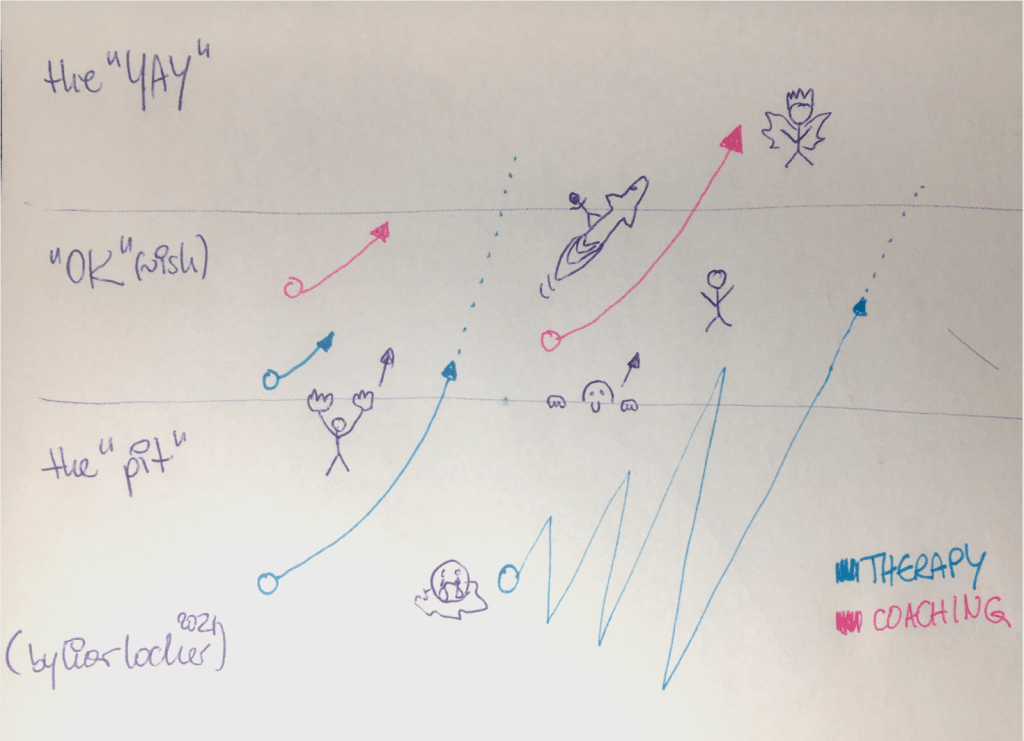
Therapy is a healthcare-type of intervention, and is typically regulated in a similar way as other ways of providing medical help. Practitioners have minimum training requirements, pass a state exam and have clear rules and regulations how, when where and in which areas to practice, and when to hand over. Therapy might be funded by the healthcare system, insurance, through a charity or occasional programs via an employer, or directly by the individual.
Coaching is largely unregulated. Coaches are qualified (or not), they might have gotten formal training (or not), their training might have featured mental health issues or boundaries between therapy and coaching (or not). Professional bodies help somewhat, but it is nowhere near as stringent as other professions. Coaching is typically funded by an organization or the individual, or occasionally comes with other programs.
Here is an overview I recently created:

And here is a more “colloquial” visualization.
Look after yourself. In times of crisis, go to A&E or call your local emergency number, or the Samaritans.
I recently ran a session on “showing up” for a network of Business Analysts. We talked about what we show, what we hide and how we hide it. (I’ll write more about it later)
The recording of the session is here.
We all look confident, well-educated and streamlined on LinkedIn. We probably also have another bio, the one that covers milestones of a different nature. Not always glorious, and always key to who and how and where we are.
Here is a snippet of mine (I shared in the webinar).

What’s in yours? How did it shape you? What have you learned?
Fancy a chat? The coaching shop is open.
 Lior Locher